Over the last two decades as a financial advisor, I’ve used a simple yet powerful framework to understand how people behave during major life transitions—whether moving into senior living, revising financial plans, or handling long-term care. It isn’t about age, income, or education. It’s about how people approach time, change and decisions.
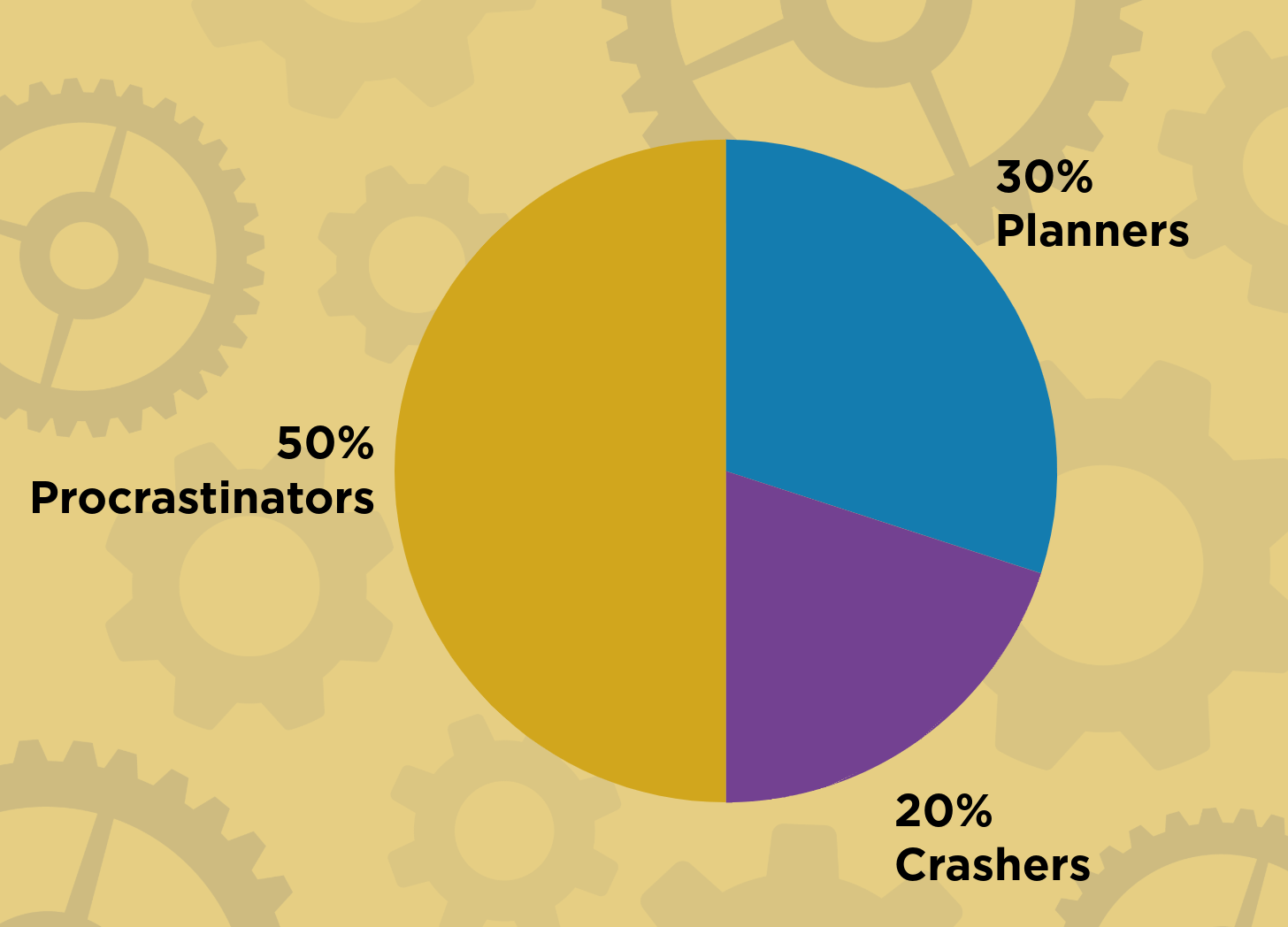
I divide people into three groups: Planners, Procrastinators, and Crashers. The model works because it matches people’s actual behavior—not how we wish they’d behave. And if you’re supporting one of these types of people—as a family member, caretaker, or advisor—this framework might be useful to you too.
I’ve also included things to think about based on which type of person you are, so you can see your blind spots better and work more effectively with advisors or anyone else helping you prepare for what’s ahead.
1. Planners (≈ 30% of people)
Planners are the people everyone says they want as clients—organized, forward-looking, and prepared. Their wills are up to date, long-term care coverage in place, and they’ve already spoken to their loved ones about what’s ahead.
They anticipate change rather than simply react to it.
But here’s the catch: Planners often don’t want to ‘buy’ advice that doesn’t improve what they have done for themselves already. They’ve read the books, downloaded the forms, maybe built their own worksheet. When advisors step in, planners don’t want them to take over—they want them to add value. Basically: Do it with me, not for me.
How to support planners:
The best way to work with a planner is to expand their field of view and bring something they haven’t considered, or serve as the Plan B safety net if they’re not the one executing the plan later.
Planners don’t need rescuing and reject the concept of being rescued. They need partners who respect their independence and add depth where needed.
As an advisor, I support planners by offering validation, deeper insight, and optional delegation. They already have a plan—my job is to help ensure it stays alive.
If you’re a planner:
You’ve already done the work, and you probably resist people who try to tell you what to do. That’s fair. But consider:
Who will execute your plan if you can’t?
Are you open to one or two blind spots being pointed out?
Do you assume you’ll always be able to handle things? (That’s often a planner’s most dangerous assumption.)
2. Crashers (≈ 20%)
Crashers are at the opposite end of the spectrum.
They don’t plan. They don’t prepare. Advice, checklists, tools—these wouldn’t inspire crashers to act even if hypothetically the crashers were aware of them. They live reactively. Eventually, life happens and they crash into consequences.
I’ve seen this pattern again and again: Despite all the resources around them, crashers soak up all of the resources and attention, and the only two things that can improve their outcomes are luck and somebody rescuing them.
Crashers aren’t always lazy or ignorant—they’re sometimes overwhelmed, disconnected from cause and effect, or caught in avoidance. But their crash, while sometimes sympathetic and sometimes avoidable, is also predictable.
How to support crashers:
Crashers represent a systems challenge. They expose where the safety nets are weak, where communication fails, where the “just in case” cushion is missing.
The goal isn’t to “fix” crashers ahead of time—but to design reactive supports that stabilize chaos when crisis hits and create a pathway to recovery. And for the planners and procrastinators among us, consider the crashers in your life that can hijack your priorities and circumstances as a maybe-rescuer.
If you’re a crasher:
If you’re reading this, you’re probably not a crasher. But if you think you might have some crasher tendencies, just know that others will end up bailing you out. So at least be the person they’ll want to help when the crisis arrives.
3. Procrastinators (≈ 50%)
Then we have the largest group, and I suspect this is where most of us live: procrastinators.
Procrastinators generally know what they should be doing. They’ve downloaded the forms, perhaps started the conversation—but something keeps them from finishing.
They might talk like planners and maybe even think they are planners, but they don’t act like them.
The mistake many professionals like me make? Trying to turn procrastinators into planners. That doesn’t work because, by definition, procrastinators have put something off that should have been addressed.
How to support procrastinators:
What actually works is to be ready for them.
When something breaks—a health issue, a family conflict, a financial surprise—that’s when procrastinators spring into action. When their options are taken away, they become motivated, self-aware, and ready to act.
The procrastinator framework aligns perfectly with what I’ve seen and learned in 30+ years as an advisor. Shaming or inspiring procrastinators into planning isn’t efficient, and is often rejected outright. What needs to happen instead is to create systems on a personal, a family, and a social level that activate when their readiness peaks, via prompts, modular options, and just-in-time support when a weak link breaks—whether that weak link is health, money, or family—and help them fix it quickly.
If you’re a procrastinator:
Stop waiting for the perfect moment—it won’t come
Identify your likely “weak link”: What will probably force your hand? A health scare? A financial crisis? A family conflict?
Set up one trigger now: “If X happens, I will immediately do Y”
Do 80% of something rather than 0% of everything
Why this framework is psychosocial, not financial
One of the truths I’ve learned: this framework has nothing to do with wealth or education. You’ll find planners earning modest incomes and crashers with six-figure salaries. This is about temperament, coping style, and how people relate to time.
Helping someone connect emotionally with their future—helping them imagine it clearly and see themselves in it—is one of the most powerful ways to reduce procrastination and prevent a crash.
The life preserver role
As I said about crashers—if you’re reading this, you’re likely not one. That means you can play an important role—as a life preserver.
Maybe you’re the planner in your family, helping a sibling who avoids decisions. Maybe you’re a procrastinator who’s finally ready to help a friend through a crisis. Whatever the case, your readiness may make the difference for someone else. And when planners, procrastinators and crashers interact, their lives and outcomes matter to each other.
Moving forward
People don’t behave like models in spreadsheets. They move between states of readiness. They sometimes plan, sometimes delay, and sometimes crash.
The Planners, Procrastinators, and Crashers framework gives us a language for that—it helps us see our families and ourselves more clearly.
Understanding which category both you and your loved ones fall into won’t automatically fix difficult situations. But it will help you stop fighting against human nature—yours and theirs—and start working with it instead.
Originally published by Tom West on Age Against The Machine.