Procrastination as we age is such a complex issue that I initially thought I’d call this Substack ProcrastinAging™. Ultimately I wanted to write about more than procrastination, but its still a main theme that keeps running through how I work with clients and think about aging.
How has procrastination changed for you as you’ve gotten older? Let me know in the comments. And if you haven’t yet, be sure to subscribe here.
Dr. “Matt” was a fantastic oncologist in the Washington, DC area, renowned for his compassion, expertise, and ability to communicate hard truths and difficult choices to patients in their fights against cancer. He was a long-time client of mine, but I also looked up to him. I even called personally about the challenging issues our family faced with my mother-in-law’s fight with cancer.
The fact that I looked up to him so much made it all the more difficult to face his family after Dr. Matt passed. It was especially hard to confront the many things he’d left undone in his planning.
However, I did not have the heart to share that with his grieving wife and adult children. “Your husband did a great job in planning with us,” I said. “We know what needs to be done and our team will help you and your kids with everything. We will go through this estate process together and keep things as easy and stress-free as possible.”
“Thanks, Tom,” his wife said. “You and your team were always part of the plan for me. And we all know Matt was always on top of the finances.”
Dr. Matt was not on top of his finances, and because of that, this would be far from easy. We had weeks of extra work ahead of us, with endless signatures and authorizations to clean up this financial picture.
His wife and children were also strangers to me and my team, despite my urging Dr. Matt for years to make changes to his estate planning and introduce us to his successor decision-makers. After this meeting with them, we audited our records for our discussions of his planning and the shortcomings we’d seen:
When we advised him to put guardrails on his documents if he ever lost capacity: “Nope, don’t want to make that change. My kids are going to have a field day with that. No thanks.”
When we told him about simple steps he could take to reduce his taxes at death by a dramatic amount: “Not going to pay that for an attorney to make that change. It’s too expensive.”
When we offered to consolidate titling of accounts for ease of administration now and down the road: “My wife won’t sign anything, she doesn’t understand any of this.”
Was this normal procrastination or something else? How is it the same or different to put things off when you are older compared to earlier (and relatively) younger ages?
Procrastination usually gets better as we age…
Procrastination is defined as the voluntary delay of intended action, despite expected or probable harm. Every parent of a teenager knows that teens are particularly susceptible to procrastination. Much of this stems from young people engaging in temporal discounting, favoring immediate rewards over long-term benefits. Their fear of disappointing parents and teachers may make them put off a task. They may also turn to easy distractions like TikTok instead of their textbooks. They may wonder, “Why do I have to do this thing when I have infinite time ahead of me?”
As we get older, procrastination usually gets better. As we “adult,” we learn that we have to get shit done to achieve our goals or avoid undesirable consequences. Fear of failure because we did not do something may motivate us to act.
But something changes with some of us as we age…like Dr. Matt. As he got older, I detected signs of loneliness and mild depression that probably contributed to him putting things off.
Denial about a material change in life might look like procrastination, but it might be more a failure to accept that the status quo can no longer be maintained. Then there’s cognitive impairment, a different animal altogether. It’s hard to get things done when you can’t find your to-do list.
…Unless it morphs into a new beast: ProcrastinAging
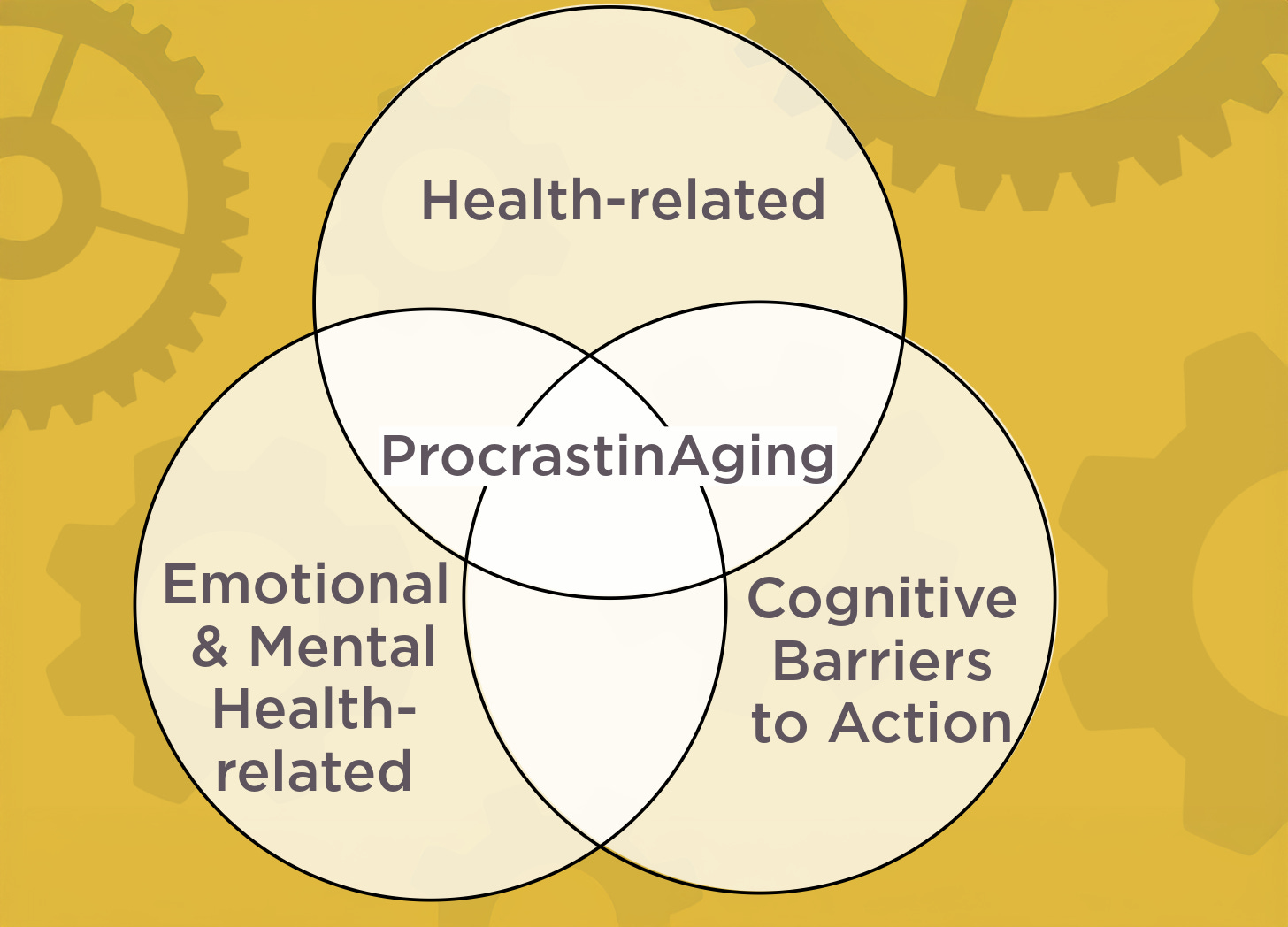
“ProcrastinAging” is a term I created to describe behaviors I have seen that look like procrastination but are something else. Think of it like procrastination with old man strength: it doesn’t flex as often as it used to, but when it does, its grip is insanely strong.
Here are the key differences between procrastination and ProcrastinAging:
A lower frequency of putting things off as we mature, but riskier consequences with the things we do put off.
A tendency to put off health care, finances, and estate planning compared to school, work, and social commitments when younger.
Having “fear avoidance” that revolves around illness, mortality, and dependence instead of the failure avoidance and short-term distractions when we’re young.
All of this happens in older adults who have the life experience to know how grave some of these behaviors can be—such as skipping medical appointments—but put them off anyway.
Here’s how you slay the ProcrastinAging beast today! Or maybe tomorrow! Next Thursday for sure!
Something as big as ProcrastinAging is not easy to slay, and I’ll dive into some of these strategies in more detail in future articles. But these five strategies are good places to start:
Break big tasks down: The daunting nature of health care or estate planning can make anyone want to put it off. Make that planning more digestible by tackling it step-by-step, triggering a sense of accomplishment by reaching each goal along the way.
Add routine and structure: Many steps make light work, and accomplishing each step is much easier when you automate reminders and find accountability partners to keep you on task.
Reframe rewards in a positive way: Fear may be a motivator, but it is also a procrastinator, too. Try focusing on what we are hopeful for and the positive outcomes we’ll achieve.
Address emotional roots directly: Many professionals in general, let alone financial advisors, avoid naming anxiety, loneliness, or depression matter-of-factly. Courage takes many forms, and we should be talking about each of these issues as we get older as a matter of course.
Attack temporal discounting head-on: Make the abstract future as tangible as possible. The more real that future seems, the more motivated you’ll be to achieve it.
Avoiding ProcrastinAging by visualizing its effects
Another effective tactic I use with my clients is asking how their “plan” might fail. I tried this with Dr. Matt. I asked him about how, when he had to recommend prescriptive treatments that also had unwelcome trade-offs such as chemo or surgery, did he get patients to comply?
“I reminded them that others have struggled with similar choices already. I told them that the patients who were most at peace with their decisions often reflected that their acceptance came down to very personal principles and a clear-sighted view of what was likely coming down the road. I also told them that putting off unwelcome trade-offs had its own risks.”
With this set up, I came back a few minutes later and asked about the recommendations to his estate plan that he had not finished. “What’s your clear-sighted view of what may be coming down the road? Are there any personal principles you want me to know related to your unfinished legal plans for you and your family? Any unwelcome trade-offs?”
He was silent for about ten seconds before he said, “You made your point, Tom. Give me the list again, and I’ll get back to you, I promise.”
I believed him, and I still believe he was sincere. When his number showed up on my phone the following week, I expected that we’d finally work on these outstanding estate issues.
Instead, it was his wife. “Oh, Tom, Matt had a stroke last night and died.”
It was devastating, and I felt terrible for his wife and children. But it also demonstrates something important: That to accomplish those goals and those many steps we take to make things as easy as possible for those we leave behind, we have to visualize what happens if we don’t. Because you do not want to let ProcrastinAging win, and you never know how long before the game is over.

Notes
“Is the Association of Procrastination and Age Mediated by Fear of Failure?” Danne, V., Gers, B., & Altgassen, M. (2023, published online 2024). Journal of Rational-Emotive & Cognitive-Behavior Therapy.
“Convergence of Age Differences in Risk Preference, Impulsivity, and Self-Control: A Multiverse Analysis.” Tisdall, L., Mata, R., Frey, R., et al. (2024). The Journals of Gerontology: Series B.
“Procrastination, Depressive Symptomatology, and Loneliness in Later Life.” Choi, E., & Lee, J. (2024). Aging & Mental Health.
“Mutual Implications of Procrastination Research in Children and Adults.” Sirois, F. M., & Pychyl, T. A. (2024). Nature Reviews Psychology.
Disclosure: Client examples are illustrative only and do not represent the experience of all clients or any guarantee of outcomes.
Originally published by Tom West on Age Against The Machine.